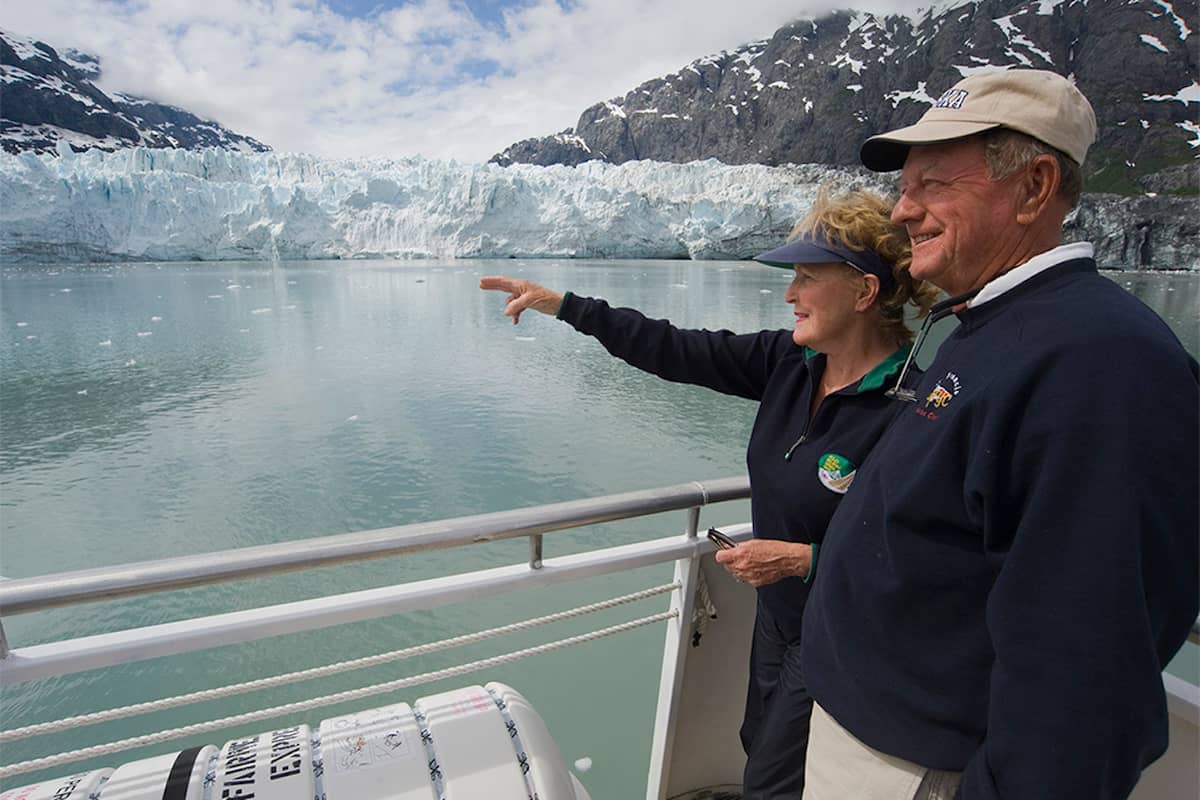
 Driest
Early season
May and June
- Wet days
- 9 a month
- June daylight
- 18.3 hrs
- Whales
- Rising from mid-June
Guides
Language
EnglishCurrency
US dollar · $GetYourGuide shows prices in the currency you choose.
Guide · Best time
Ships sail into the bay from May to September, and each month trades something. Here are the measured temperatures, rain days and daylight near the park, plus what changes for whales and for the glaciers you can reach.
Editorial team, glacierbayalaskacruise.comUpdated October 17, 2026Reading time 6 min15 sources
Quick answer
An Alaska cruise to Glacier Bay in summer falls somewhere between May and September. The park counts May and September as its shoulder season for cruise ships, and June, July and August as its prime season.5 Its main visitor season runs from late May to early September, with July as the peak.1
Each part of the season has a character of its own. May is cool and fresh, with snow still low on the mountains. June brings the longest days. July and August are the warmest and the busiest, with the most whales. September turns wetter and darker, but it opens an inlet that is closed for most of the summer. Think of the edges of the season as quieter and cooler, and the middle as warmer, busier and better for wildlife. Neither end is a poor choice, as long as you know what you are trading.
No month buys you good weather. The park reports about 4 sunny days per month in Southeast Alaska in an average year.4 Summer highs in the bay run between 10 and 15 °C.6 Plan for cloud and rain, enjoy the sun if it comes, and pick your month for the things that do follow the calendar: light, wildlife and the rules on where ships may go.
The season
May
Cool and fairly dry, with 9 wet days on average.2
May 1 to June 30
No vessels may enter while the seals pup.7
Mid-June
Humpback numbers rise from mid-June.3
July
September
Johns Hopkins Inlet opens to cruise ships on 1 September.8
Search for a sunny July in Glacier Bay and you will find dazzling photographs, but the numbers are more modest. At the weather station at Gustavus, near the park entrance, July counts 11 wet days of 2.5 mm or above and 116 mm of rain in all.2 That is more than May or June, and less than August or September. July is warm and busy rather than dry.
It is, though, the warmest month. The average daily high in July is 17.8 °C, and the average low 9.1 °C.2 On the deck of a moving ship in front of the ice it feels a good deal colder, especially in wind, and moist sea air makes a cool day feel colder still. Gloves and a hat are worth packing in July too.
July also brings the crowds. It is the peak of the park's visitor season.1 Inside the park that matters less: no more than two cruise ships may enter the bay on any day.9 The ports and shore excursions around your Glacier Bay day are where July feels busy, and that is worth knowing if you plan to book outings in Juneau or Ketchikan.
Climate
Month by month
| Month | Daylight (h) | Darkness (h) | High / low | Wet days | Cruise ship season |
|---|---|---|---|---|---|
| Jan | 7.1 | 16.9 | 3 / -3 °C | 15 | No cruise season |
| Feb | 9.2 | 14.8 | 3 / -6 °C | 10 | No cruise season |
| Mar | 11.6 | 12.4 | 5 / -5 °C | 8 | No cruise season |
| Apr | 14.3 | 9.7 | 9 / -1 °C | 10 | No cruise season |
| May | 16.8 | 7.2 | 15 / 2 °C | 9 | Shoulder season |
| Jun | 18.3 | 5.7 | 17 / 6 °C | 9 | Prime season |
| Jul | 17.6 | 6.4 | 18 / 9 °C | 11 | Prime season |
| Aug | 15.4 | 8.6 | 17 / 8 °C | 13 | Prime season |
| Sep | 12.7 | 11.3 | 14 / 5 °C | 14 | Shoulder season |
| Oct | 10.1 | 13.9 | 9 / 1 °C | 14 | No cruise season |
| Nov | 7.7 | 16.3 | 4 / -2 °C | 15 | No cruise season |
| Dec | 6.4 | 17.6 | 2 / -4 °C | 15 | No cruise season |
For each month near the park: sunrise-to-sunset hours at its midpoint, the usual high and low, and the count of days that bring 2.5 mm of rain or snow; NOAA, 1991 to 2020.2 Season according to National Park Service.5
Three seasons
DriestMay and June
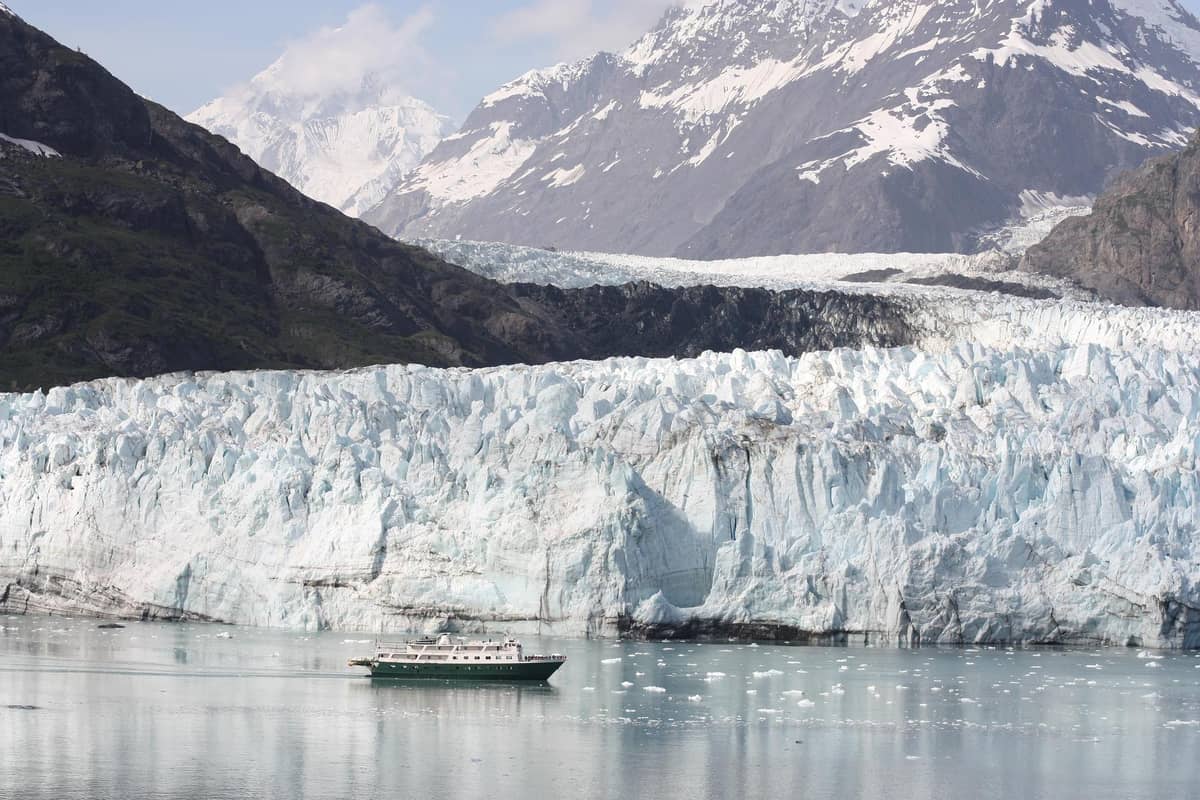 Warmest
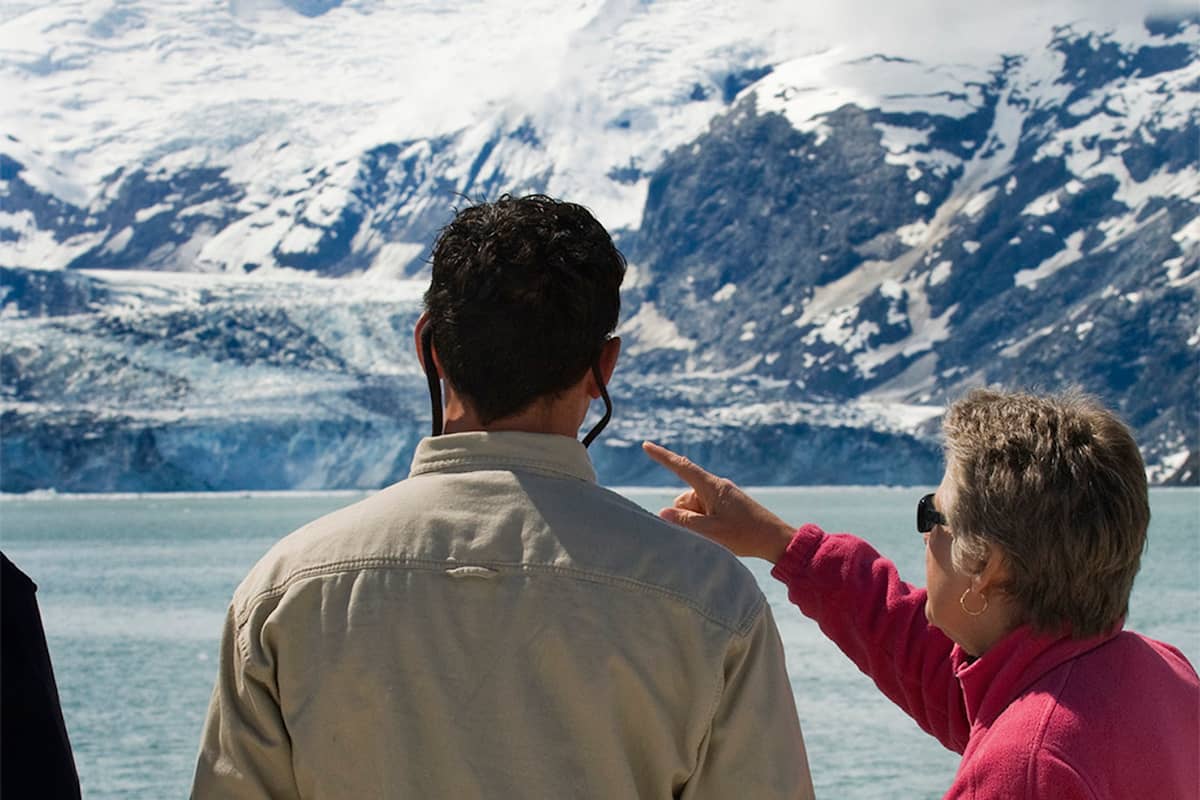 Quietest
Decision helper
Pick the line closest to what you want
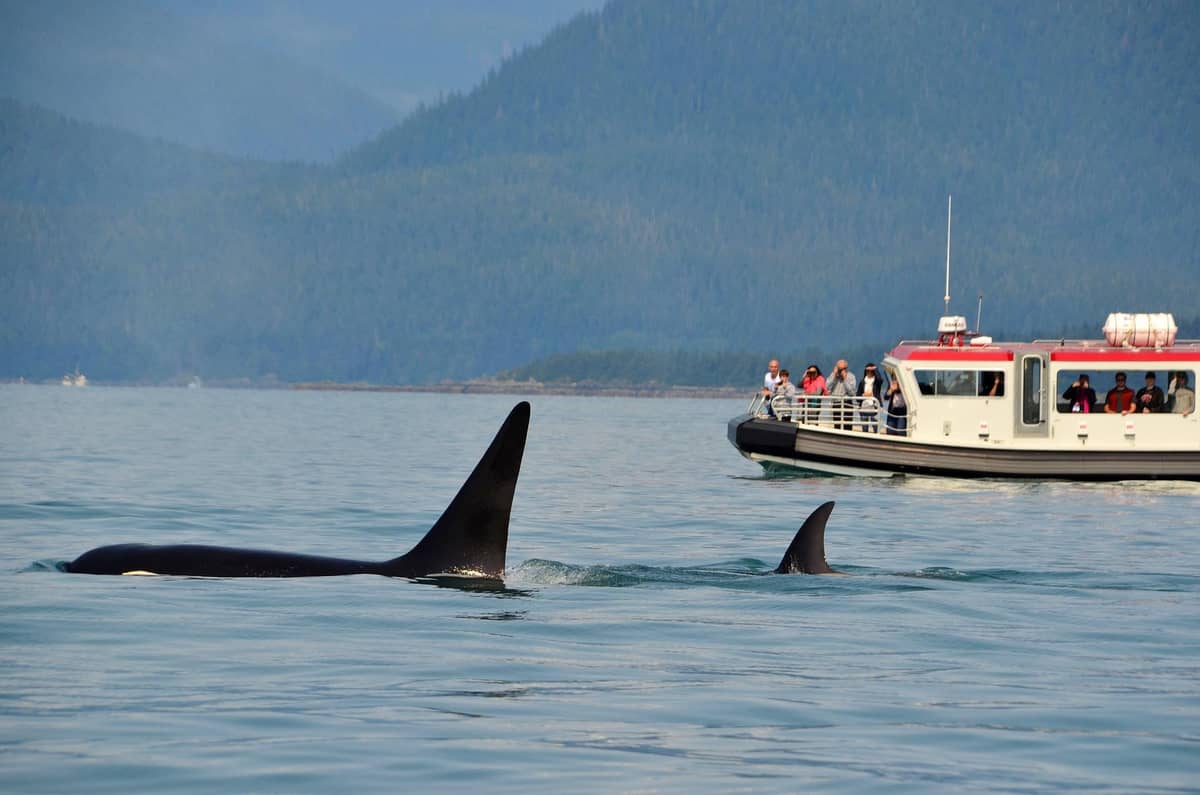
Whale numbers typically rise in mid-June, peak in July and August, are somewhat lower in April, May and September and are lowest from October through March.
The early season holds the best weather odds. At Gustavus, May and June both count 9 wet days on average, and May gets only 71 mm in the month.2 The days are long: the sun is above the horizon for 18.3 hours at mid-June.2 That light gives you more hours of good viewing on a long day in the bay.
An Alaska cruise to Glacier Bay in June has a few things to weigh. It is cooler than July, with an average high of 16.6 °C and a low of 6.2 °C.2 Whale numbers only begin to rise in mid-June.3 And Johns Hopkins Inlet is closed to all vessels from May 1 to June 30 each year, for the harbor seals that gather there.710
May is cooler still. The average high is 14.6 °C and the average low 2 °C.2 Snow lies lower on the peaks, which makes for striking photographs of white mountains above blue ice. Early-season sailings are also among the first of the year, and the ports feel calmer before the summer rush. Bring warm layers and enjoy the fresh start.
Checklist
Cost calculator
Add your travelers to one of the trips for a starting total.
Total from$4,093
per participant from $2,047
Check availabilityfree cancellationTotals use each listing's lowest per-traveler price on GetYourGuide, turned into your currency with the euro reference rate; you see the exact sum when you book.
Video
Nothing loads from YouTube until you tap play.
Midsummer is the season for wildlife. Humpback whale numbers rise in mid-June, peak in July and August, and are lower again in September.3 The whales come to feed in the bay in summer and spend the winter elsewhere to breed.11 From a cruise ship you may see their spouts in the lower bay, where they are most often found.12
The warmth lasts into August. The average high is 17.2 °C and the low 8.2 °C.2 Rain picks up, though: August averages 13 wet days and 154 mm.2 Daylight shortens too, to 15.4 hours at mid-month.2 An August cruise trades a little weather for the best odds of whales and a warm deck.
Glacier access stays the same through both months. For most of the summer, cruise ships go to the face of Margerie Glacier in Tarr Inlet but turn around at Jaw Point, where passengers see Johns Hopkins Glacier from 7 miles away.13 If seeing both great glaciers up close matters to you, look at the end of the season instead.
An Alaska cruise to Glacier Bay in September is a gamble that sometimes pays off. It is the wettest month of the season at Gustavus, with 14 wet days and 172 mm on average.2 The average high drops to 14.3 °C and the low to 4.9 °C.2 Daylight falls to 12.7 hours at mid-month.2
In return, an inlet opens. The park allows cruise ships into Johns Hopkins Inlet only in late summer, once its harbor seal protections end.14 Even after the inlet opens to cruise ships on 1 September, only a small number travel all the way to the face of the glacier.8 It is a chance, not a plan, and your ship's captain decides on the day.
September is also a shoulder month for the park's cruise quota.5 Fall colors creep into the lower slopes, and the light is lower and warmer. Whale numbers are lower than in midsummer but not gone.3 For travelers who dislike crowds and do not mind rain, it is a quiet way to see the bay. Pack as you would for a wet spring day at home, add an extra warm layer for the open deck, and the rain will matter far less than you fear.
If weather is your main worry, choose late May or June: fewer wet days and the longest light. If whales matter most, choose July or August. If you hope to see Johns Hopkins Glacier closer than from Jaw Point, choose September and accept the rain. There is no single best month, only a best month for what you want to see.
Whatever the month, dress for a cold deck. The park suggests waterproof boots, rain gear, a hat, gloves and wool or pile layers or a warm coat.15 Binoculars help in every season; from a big ship, wildlife on the shore looks smaller than you expect. A morning in front of the ice can feel like early spring even when the ports below were warm.
The trip this site books is a 9-day package from Vancouver with Glacier Bay National Park on day 6, from $2,047. Check the dates offered on the listing; the month you choose decides much of what you see. No traveler has reviewed this new listing so far; it lets you hold a place before paying, and dropping out is free until 24 hours beforehand.
Plan the voyage
Book today, pay nearer the time, and cancel at no charge until 24 hours ahead.
It depends on what you want. June has fewer wet days, July and August more whales, and September access to Johns Hopkins Inlet.2314
Not reliably. July averages 11 wet days at Gustavus, and the region sees about 4 sunny days a month.24
Cool. July, the warmest month, averages a high of 17.8 °C at Gustavus.2
July and August. Humpback numbers rise in mid-June and peak in July and August.3
Only late in the season. Cruise ships may enter Johns Hopkins Inlet only in late summer, once seal protections end.14
In May. The park's seasonal quotas apply from May to September.5
Very long. The sun is above the horizon for 18.3 hours at mid-June.2
Sources
Keep reading